Scientific Report
Material Analysis of
Canvas Support –
Sample No. 4991/5
Subject and Objective of the Study
The subject of this analysis is a fragment of painting canvas (warp and weft) identified as sample 4991/5. The primary objective of the study was to verify the hypothesis that the object originates from the Roman artistic environment of the Early Baroque period (circa 1598–1600) by characterizing the nature of the fibers and the technology used in the production of the support. The fibers examined were by Dr. Mirella Baldan.
1. Botanical and Microstructural Characteristics of the Fibers
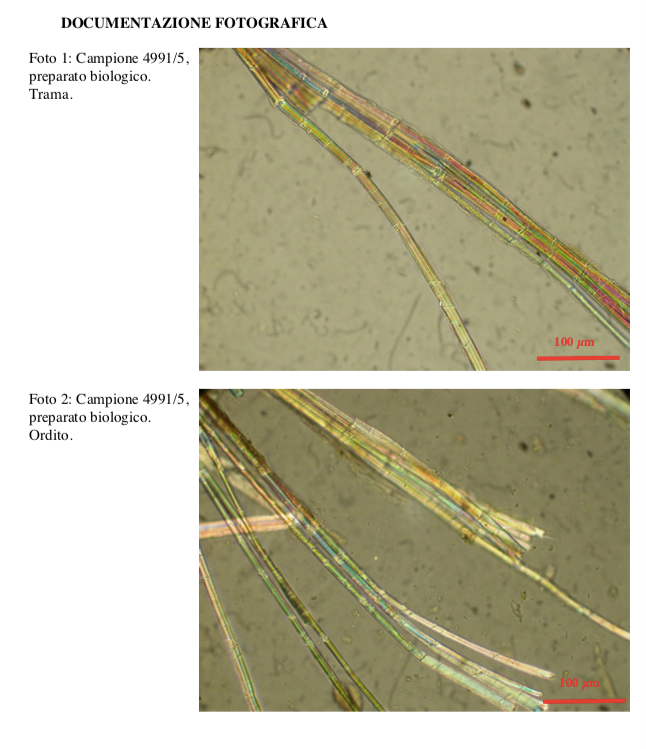
Microscopic analysis of fibers extracted from both the weft (trama) and the warp (ordito) demonstrated full material homogeneity. The examined material was identified as linen (Linum) of a plant-based, cellulosic nature.
During observation via optical microscopy, the following diagnostic features were identified:
- Geometric Parameters: The fibers exhibit a diameter ranging from 10 to 15 um. This corresponds to the parameters of high-quality linen historically utilized in easel painting.
- Surface Morphology: The analysis revealed numerous transverse striations (striature trasversali), which intersect at various points to form the „X” shape characteristic of linen, often referred to as „linen nodes”.
- Fiber Terminations: Pointed terminations (estremità appuntite) were observed. This is a distinctive feature of linen, allowing for the exclusion of hemp admixtures, as hemp fibers typically exhibit blunt or bifurcated ends.
2. Construction and Technological Parameters of the Fabric
The weave structure and thread density of the sample provide critical data regarding the workshop in which the support was produced:
- Weave Type: A plain weave (simple weave) was utilized. This was the most stable and prevalent structure in Roman painting at the turn of the century.
- Density and Weight: The fabric exhibits a density of 7–8 threads per 1 cm in both the weft and warp. Such a medium-weight grammage provided the necessary mechanical stability for large Baroque compositions and ensured proper adhesion for thick ground layers.
- Manufacturing Uniformity: The equal number of threads in both directions indicates a high-quality loom, which was standard for Roman textile manufactories supplying masters such as Caravaggio.
3. Analysis of the Impregnation Layer and Historical Context
Laboratory examination revealed the presence of a brownish organic substance impregnating the canvas fragment. This is most likely colletta (animal glue, e.g., rabbit-skin glue), functioning as an insulating layer (imprimitura).
- Role of Impregnation: This layer protected the fibers from the destructive effects of the oil binder contained within the paints.
- State of Preservation: The brownish coloration of the substance results from the natural aging processes of the organic binder or resinous admixtures, further substantiating the age of the object.
The selection of linen with these characteristics in Rome circa 1600 has a profound technological justification. During this period, there was a massive transition from wooden panel supports to canvas, facilitating the creation of monumental altarpieces. Linen, due to its elasticity and smooth structure, allowed for the precise modeling of chiaroscuro, which was essential to the aesthetic of the emerging Baroque style.
4. Conclusion
Based on the provided documentation and the conducted laboratory tests, it is concluded that the support material is linen with a fiber thickness of 10–15 um and the weave parameters (7 x 7 / 8 x 8) demonstrate full technological compatibility with the practices of Roman painting workshops of the late 16th and early 17th centuries. The total absence of synthetic fibers, cotton, or traces of modern spinning methods excludes a modern origin of the support and confirms its authentic, historical character.
Bibliography:
- Catling, D., Grayson, J. (1982). Identification of Vegetable Fibres. London: Chapman & Hall. (Standard reference for the microscopic identification of linen based on „X” nodes)..
- Christiansen, K. (1986). Caravaggio’s ‘alla prima’ Technique. [in:] The Burlington Magazine, Vol. 128. (Analysis of supports used by Caravaggio in Rome circa 1600).
- Conti, A. (2007). History of the Restoration and Conservation of Works of Art. Oxford: Butterworth-Heinemann. (Description of historical colletta impregnation methods).
- Eastaugh, N., Walsh, V., et al. (2004). The Pigment Compendium: A Dictionary of Historical Pigments. Oxford: Elsevier. (Information on the aging of historical organic binders).
- Keith, L. (1998). Three Paintings by Caravaggio. [in:] National Gallery Technical Bulletin, Vol. 19. (Comparative data on the density of Roman linen canvases).
- Villers, C. (2000). The Fabric of Painting. London: Archetype Publications. (Analysis of weaves and weights of canvases in Baroque painting).
“Études has saved us thousands of hours of work and has unlocked insights we never thought possible.”
Annie Steiner
CEO, Greenprint